For busy professionals who have tried the trackers, the supplements, the morning routines, and still wake up tired, achy, or one emergency away from collapse.
Why Rest Isn't Working. And What One Change Would Help Most.
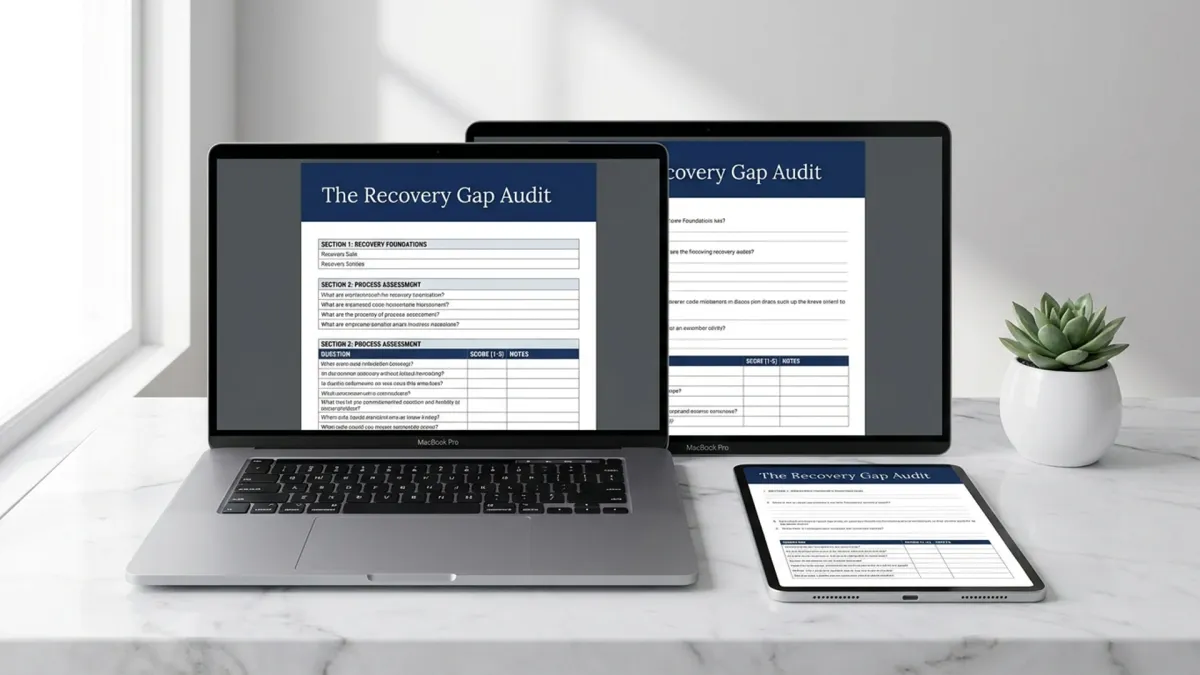
The Recovery Gap Audit. A 70-question self-assessment built on 25 years of clinical observation. It tells you exactly where your total load exceeds your recovery capacity, and which single change will give you the most relief. No supplements. No protocols. No adding a single thing to your already-full plate, even if you have tried everything else and still feel the weight.
70 questions Whole-life audit | 14 sections Across Load & Capacity | 10 min To complete | 25 yrs Clinical observation | £17 Instant download
THE WELLNESS TRAP
How Smart, Overloaded Professionals Build a Lighter Life
People don't wake up thinking 'I need a whole-life energy audit.' They wake up tired. They wake up with a to-do list that already feels hostile. They wake up knowing, somewhere in the back of the mind, that something is off. Something is costing more than it should. Something needs to go.
But they can't name it. So they reach for the thing the wellness industry always sells them: more. Another supplement. Another tracker. Another protocol that demands their attention before they've had their coffee.
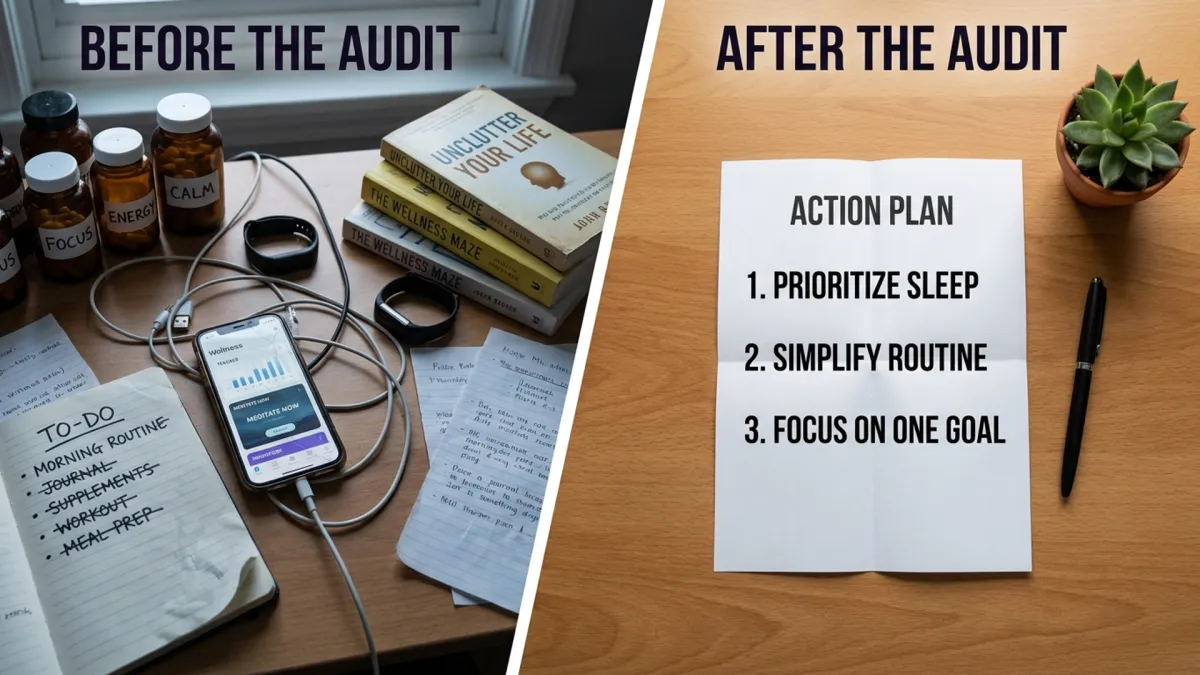
You've tried the apps. The cold plunges. The 5am club. The stacks of pills that cost more than a decent weekend away. Every single one of them added something to your plate. Every single one of them made the problem worse.
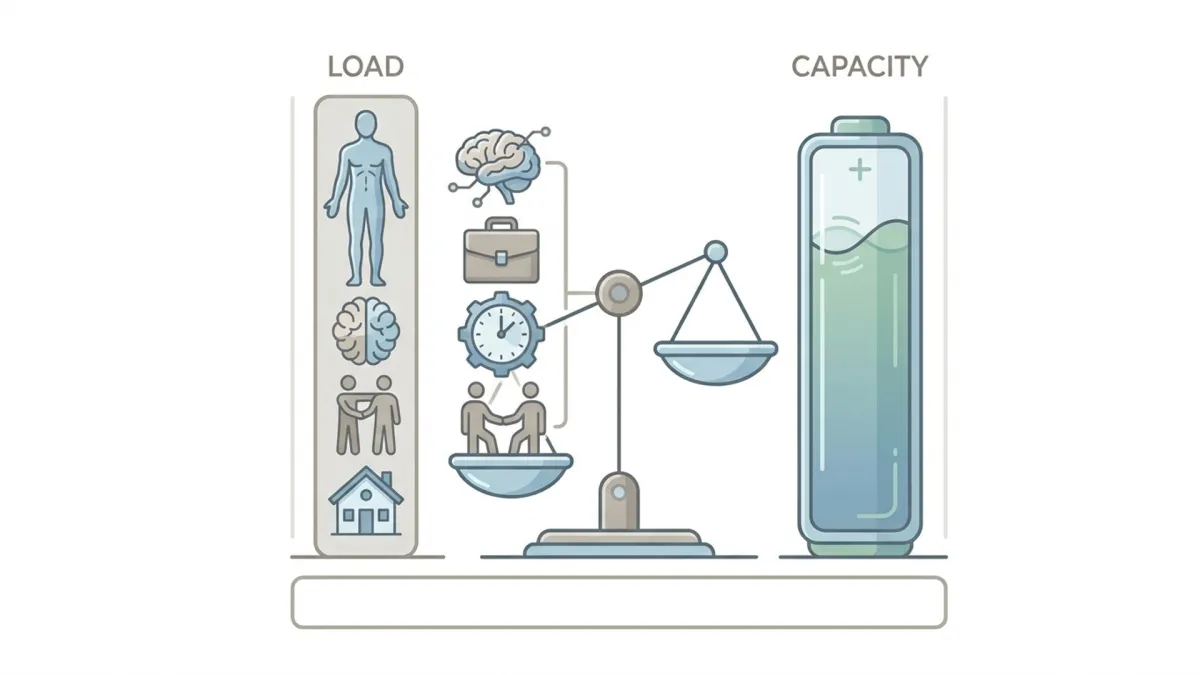
Here's the thing most health advice won't tell you: you're probably not broken. Your system is just full. The total demands on your body, your mind, your work, your relationships, and your environment exceed your ability to recover from them.
That's not a character flaw. It's a gap. And you can measure it. The Recovery Gap Audit helps you do exactly that. In about ten minutes, you see the number. You see which domains are bleeding you dry. And you see the one change that will give you the most capacity back.
What Makes This Different
Most health assessments ask you the wrong question. They ask 'what are you not doing enough of?' More steps. More greens. More meditation. More discipline. The Recovery Gap Audit asks a different question altogether: what is quietly draining you that you've stopped noticing?
It works because it's built on a simple idea that most health advice ignores. Your body is an organism nested inside ecosystems. Physical. Nutritional. Mental. Emotional. Work. Relationships. Environment. When the total load across all of them exceeds your capacity to recover, symptoms appear. Tiredness. Pain. Overwhelm. The stuff that doesn't resolve no matter how much you rest.
The audit has three pieces, and each one is designed to help you see the gap clearly.
Piece One: The Load Assessment
Thirty-five questions across seven domains. Physical load. Nutritional and metabolic load. Mental load. Emotional load. Work load. Relationship load. Environmental load. You rate each one on a simple 0 to 5 scale based on the last two to four weeks. No ambiguity. No vague wellness language. Just honest answers to honest questions.
Piece Two: The Capacity Assessment
Thirty-five more questions across seven recovery domains. Sleep and rest. Nourishment and hydration. Intentional relaxation. Movement and physical capacity. Connection and emotional support. Autonomy and margin. Play, joy, and creative expression. Higher scores here are better. They tell you where your recovery is holding and where it's crumbling.
Piece Three: The Action Plan
Your Recovery Gap score is one number. Total Load minus Total Capacity. It falls into one of four tiers, from Manageable through to System Overload. The audit tells you which tier you're in, names your top three load sources, identifies your biggest capacity drain, and walks you through choosing one thing to stop, reduce, or let go of.
The reflection prompts at the end are where the real insight happens. 'When you try to rest, what actually happens?' 'What have you already tried that didn't work?' 'Complete this sentence honestly: the thing I suspect is quietly draining me, but I haven't wanted to look at, is...'
These are the questions that tend to produce the clearest personal insight. The ones most people avoid because the answers are uncomfortable. And when someone sees the number, sees the pattern, and names the drain, the whole conversation changes. They stop wondering whether they need another system. They start trusting that they can read their own terrain and act on it.
What One Unnamed Drain Costs You
Let me put this in concrete terms.
A single energy drain you can't name costs you every day. It costs you focus in the morning. It costs you patience in the evening. It costs you the ability to be present with the people who matter most.
You don't notice it because it's ambient. It's the background hum of a life that is too full.
The Recovery Gap Audit costs £17. But the real math is on the other side of the equation.
One named drain, addressed, gives you back time and energy you didn't know you were losing. One thing you stop doing, or reduce, or let go of might be the thing that has been quietly costing you for months. Maybe years.
The whole audit takes about ten minutes. The action plan takes another ten. That's it. Twenty minutes to name what's been draining you and pick the one change that will give you the most relief.
Twenty minutes. £17. Against months of tiredness you couldn't explain.
The Old Way of Trying to Feel Better
You already know this list. You've lived it.
- Search for answers online and find contradictory advice from people who've never met you.
- Buy another supplement because someone with good lighting said it changed their life.
- Download another app that promises to optimise your sleep, your steps, and your stress.
- Add another protocol to a morning routine that's already crumbling under its own weight.
- Blame yourself when the new system doesn't stick. Assume you're the problem.
- Keep adding. Keep hoping. Keep wondering why nothing changes.
The Recovery Gap Way
This goes in the opposite direction.
- Answer 70 honest questions across 14 life domains in about ten minutes.
- Calculate your scores. See your Recovery Gap as a single, concrete number.
- Read your interpretation guide. Know which tier you're in and what it means.
- Identify your top three load sources and your biggest capacity drain.
- Choose one thing to stop, reduce, or let go of. One change for maximum relief.
- Complete the reflection prompts that ask the questions most people avoid.
THE DELIVERABLES
Exactly What You Get
- The Recovery Gap Audit PDF (9 pages): A 70-question self-assessment across 14 life domains that shows you exactly where your total load exceeds your recovery capacity, even if you've never done any kind of structured self-reflection before.
- The Load Assessment (35 questions, 7 sections): Maps every source of demand on your system: physical, nutritional, mental, emotional, work, relationships, and environment, so you see the full picture instead of treating each symptom in isolation.
- The Capacity Assessment (35 questions, 7 sections): Measures your recovery across sleep, nourishment, relaxation, movement, connection, autonomy, and joy, so you know which foundation is cracking and which is holding.
- The 1:1 Scoring System: Gives you a single Recovery Gap number, no complicated multipliers or weighted formulas, so you can calculate it yourself in under a minute.
- The Interpretation Guide: Four clear tiers from Manageable to System Overload, so you know whether you need a minor adjustment or a systematic load reduction.
- The Action Plan page: Walks you through naming your top load sources, your biggest capacity drain, and the one change to make first, so you don't stare at your results and do nothing.
- The Reflection Prompts (5 questions): Asks the things most people avoid: what have you already tried, what might be quietly draining you, what would you be willing to change if someone showed you how, so the real insight has room to surface.
- Instant download. No waiting. No login. Complete it today.
The 30-Day Clarity Guarantee
Take the audit. Answer all 70 questions honestly. Calculate your scores. Read your interpretation guide.
If after completing it you don't have a clearer picture of what's draining you than you did before, I'll refund your £17 in full.
No forms. No hoops. No 'prove you did the work.'
I'm not asking you to feel better. Feelings are vague and they take time. I'm asking for something specific. You should be able to name your top load source, your biggest capacity drain, and the gap between them. If you can't, you pay nothing.
You keep the audit. You keep the action plan. You keep everything.
Two Included Bonuses
Bonus #1: The Quick-Start Video Walkthrough
(For when you want someone to show you, not tell you.)
A 12-minute screen-share walkthrough of a real Recovery Gap Audit being completed, scored, and interpreted. I talk through what each section is actually measuring, how to answer honestly when the question feels uncomfortable, and how to read your results once you've got your number.
Here's what you get:
- A guided walkthrough of a completed audit with real scores
- How to approach the questions that feel hardest to answer
- How to interpret your tier and pick your first action
Bonus #2: The Common Patterns Guide
(For when you stare at your results and think 'is this normal?')
Four recurring Load and Capacity patterns from 25 years of clinical observation. If your scores look like Pattern 2, here's what that usually means and where to look next. You don't have to interpret your results alone.
Here's what you get:
- Four named patterns with the typical domain signature for each
- A short explanation of what each pattern usually points toward
- Where to start subtracting based on your specific pattern
The Optimisation Era Is Ending
People are exhausted. The trackers, the protocols, the self-surveillance, the endless adding: it hasn't made us healthier. It's made us more anxious. More tired. More convinced that the problem is us.
The people who will feel better in the years ahead are the ones who learn to subtract. Who know what to protect. Who can read their own patterns and act on them without waiting for permission from an app or an influencer.
That shift is already happening. The question is whether you want to spend another year adding things to a life that's already full, or whether you want to spend twenty minutes finding out what to take off.
What If I've Never Done This Before?
The Recovery Gap Audit was built for people who have tried everything and are tired of trying. It was also built for people who have never done any kind of structured self-reflection and don't know where to start.
The questions are straightforward. The scoring is simple subtraction. There's no jargon. There's no philosophy to adopt. You don't need to believe in anything except the idea that your body responds to the total load placed on it.
If you can answer 70 honest questions and do basic arithmetic, you can complete this audit.
TL;DR
For The Scrollers
Here's what you get when you download The Recovery Gap Audit for £17:
- The Recovery Gap Audit PDF: a 70-question self-assessment across 14 life domains
- The Load Assessment: 35 questions mapping every source of demand on your system
- The Capacity Assessment: 35 questions measuring your recovery across seven foundations
- The 1:1 Scoring System: a single Recovery Gap number in under a minute
- The Interpretation Guide: four clear tiers from Manageable to System Overload
- The Action Plan page: name your top loads, your biggest drain, and your first change
- The Reflection Prompts: five questions that surface what most people avoid
- Bonus: The Quick-Start Video Walkthrough (12 minutes)
- Bonus: The Common Patterns Guide (four recurring patterns from 25 years of clinical observation)
And the 30-Day Clarity Guarantee: if you can't name your top load source and your biggest capacity drain after completing the audit, you get a full refund and keep everything.
SUPPORT & CLARITY
Questions You Might Have
Still wondering if the Recovery Gap Audit is the right next step for you? Read through our most common questions.
If you need further clarity before proceeding, our team is ready to assist. Reach out directly to us at [email protected].
What exactly am I getting?
The Recovery Gap Audit is a 9-page PDF. It contains a 70-question self-assessment (35 Load questions, 35 Capacity questions), a scoring system, an interpretation guide with four tiers, an action plan template, and five reflection prompts. You also get the Quick-Start Video Walkthrough and the Common Patterns Guide.
How long does it take?
About ten minutes to complete. Another ten minutes to score, read your interpretation, and fill in the action plan. Twenty minutes total.
Is this a medical assessment?
No. It is an educational self-assessment tool based on the Load and Capacity Framework. It will not diagnose you. It will not tell you what supplement to take. It will help you see what is quietly weighing you down, which is often more useful than another diagnosis.
Who is this for?
Busy professionals who are tired, in pain, or overwhelmed and can't figure out why. You've tried the apps, the supplements, and the routines. Something is off but you're too stretched to name it. This audit helps you name it.
Who is this not for?
If you're looking for a supplement protocol, a meal plan, or someone to tell you exactly what to do, this isn't for you. The audit gives you a map and a framework. You do the reflecting. You choose the change.
How is this different from a wellness questionnaire or a personality test?
Most wellness questionnaires ask 'are you drinking enough water?' and give you generic advice. The Recovery Gap Audit measures your total load against your total recovery capacity using a structure developed from 25 years of watching what actually helps people recover and what makes them worse. It gives you a number, not a vague category. And it asks the questions most assessments avoid, including the ones about emotional load, relationship drain, and environmental stress.
What does the score actually tell me?
Your Recovery Gap is your Total Load minus your Total Capacity. A gap of zero or below means you're coping. A gap of 1 to 15 is a mild imbalance that needs minor adjustments. A gap of 16 to 40 means your system is carrying too much and you're likely noticing symptoms. A gap of 41 or above means the priority is systematically reducing load, ideally with professional support.
Can I use this with clients or patients?
Yes. The audit is designed as a self-assessment tool that practitioners can use with the people they support. If you're a coach, therapist, or healthcare professional, you're welcome to use it as a structured conversation starter.
Is there a guarantee?
Yes. If after completing all 70 questions you can't name your top load source and your biggest capacity drain, I'll refund your £17. You keep the audit and both bonuses.
What happens after I take the audit?
That's up to you. You'll have a clear picture of your Recovery Gap, your top load sources, and your biggest capacity drain. The action plan helps you pick one change. After that, if you want to go deeper, there's a free interactive version of the Load Compass at loadandcapacity.com that tracks your pattern over time. But there's no upsell embedded in the audit itself. The PDF does what it says.
Start The Recovery Gap Audit
You've spent enough time adding things to a life that's already full. Protocols. Trackers. Habits. Supplement stacks. Every one of them promised to fix what was broken. Every one of them added weight.
The Recovery Gap Audit goes the other way. It helps you find what to take off.
You get the full 70-question audit, the Load and Capacity assessments, the 1:1 scoring system, the interpretation guide, the action plan, the reflection prompts, the Quick-Start Video, and the Common Patterns Guide. All of it for £17.
If after completing the audit you can't name your top load source and your biggest capacity drain, you get a full refund and keep everything.
© 2026 The Natural Flow Method. All rights reserved.